
Peace Himalaya – Team Italy
In the heart of the hilly jungle in remote Makwanpur, Nepal, right outside the town of Manahari, lies a scattered Rawang village where part of the Chepang community lives. The Chepang people are an indigenous ethnic group primarily residing in the central and mid-hills of Nepal. Historically, they have been semi-nomadic, living in remote, forested areas, and their lifestyle has traditionally been based on subsistence farming, hunting, and gathering, relying heavily on forest resources for food and medicine.
The children from this particular village do not yet have any form of school to attend.
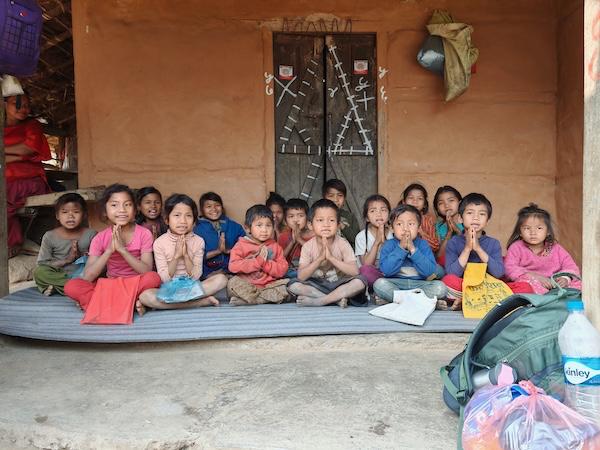
A team from Peace Himalaya – Italy recently had the opportunity to visit some families and children, distributing materials to support the early stages of non formal schooling in a small room of a local family’s house, supported by Peace Himalaya.
The Chepang are often regarded as a marginalized group in Nepal, facing challenges such as systemic discrimination, poverty, land insecurity, and limited access to education, to name a few.
Twenty-nine-year-old Sanu Maya is worried about her daughter, who is just seven. “To walk every day for 4 to 5 hours on a steep and dangerous path to reach the school in distant Manahari Bazar is impossible,” she said. However, some of the older children take on these challenges.
We also visited two formal schools in the highway areas, where the inflow of Chepang children is high due to hunger. These children mostly come from families that have migrated near the highway and survive on daily casual labour. Worsening the situation, the school only provides a 15-rupee meal per child—roughly 0.10 €.
“But this doesn’t provide enough food and nutrients to sustain their daily effort to reach school,” adds Sanu Maya.
Given that their parents cannot afford to give them a lunch box, many children are often too hungry to attend school regularly and end up staying home with their families. Rice is only consumed on special occasions, such as festivals or when they gather enough money through casual labour in the nearby town. This often leads to children dropping out of school and ending up as child laborers in highway hotels, restaurants, or sand/stone mining on the riverside.

Returning to Rawang village, it takes around a 3-hour walk to reach the nearest health center and basic service providers. As a result, most people in the community are not vaccinated and live in extremely precarious hygiene conditions, exposing them to deadly diseases such as poliomyelitis and tetanus, which are normally preventable through a simple injection.
The story of Pabita is the story of many women in the Chepang community: 27 years old and now a mother of eight, she got married as a child and had her first baby at the age of 13. When they are not at home taking care of the house and children, women work on the land. The harvest is highly dependent on weather conditions, with the main products being cereals like maize or millet and gundruk (dried spinach), which they use to make achar (a type of pickled condiment).
Nonetheless, what they cultivate is barely enough for six months; the rest of the time, they depend on casual labor and the food they can find in the jungle, such as mushrooms and yams. We also heard that some of them have lost their lives due to poisonous wild food.
“Nonetheless, we are very good at recognizing non-poisonous roots, as we rely on our inherited indigenous knowledge,” Sanu Maya expressed with confidence.
Sunita, 36, is the mother of five children. Two of her sons, one 17 and the other 15 years old, “go down” every day for casual labour so that they can feed their family of seven, while her daughter walks a long distance every day to study in Manahari Bazar.
“Getting better is a ‘fruit in the sky’ that we’ll never get,” she sighed. Nonetheless, Sunita is extremely convinced that education is of primary importance, and she believes that supporting the development of the ongoing informal schooling is crucial for the future of her children.
At the moment, the informal school is still in a very vulnerable condition, as it lacks proper space, materials, infrastructure, and staff. Currently, Namuna, 23, also belonging to the Chepang community, serves as a voluntary teacher supported by Peace Himalaya, commuting on foot every day from Manahari to provide basic education to the children.
Peace Himalaya distributed new uniforms, tracksuits, sandals, and stationery to the 16 children attending informal schooling, while 10 younger children are on the waiting list to join soon. Supporting them in any way is crucial. Together, we can help them reach their fruit in the sky.
We are happy to share our experiences with you. Please feel free to contact us.